Create Cultural Value
Give the people of Manitowoc more ways to engage with art, from seeing large-scale work take shape inside a local foundry to meeting the artists who make it.
Arrow Designs

Work / 02
Structures, mechanisms, and production minded systems made to perform in the real world.

A Six- foot cast metal mandala in aluminum, stainless steel, aluminum bronze and polished red brass. The petals are 26 solid parts, hand sculpted and mirrored on center, built within a 40° jig so nine castings would close into a perfect circle. Every step ran through the residency's documentation system, from research at the Field Museum to the final weld and finishing.


By clicking this button you agree to the WaF terms and will not copy, redistribute, or screen record WaF content. Unauthorized reproduction will be pursued legally.
WAF Artist Residency
Wisconsin Aluminum Foundry in Manitowoc pours metal for industry every day.
The residency I built asked whether the same floor, crew and process could produce large-scale sculpture, and whether every step could be captured so the knowledge outlasts the project. In the trial year I framed out the program and built the systems as I went: the structure, the partnerships, and the tools that document how art gets cast.
A working foundry already has the skill, the equipment and the people. The residency gives that capacity a second purpose.
Give the people of Manitowoc more ways to engage with art, from seeing large-scale work take shape inside a local foundry to meeting the artists who make it.
The people who pour metal every day became collaborators, not contractors. Their knowledge is the material the art is made from. Community projects put that skill on display and celebrate it.
Give local artists the time and space to create, plus the tools to document their process and share the finished work.
Bring institutions, artists and makers together around shared projects, so the work made here inspires others to collaborate in their own communities.
Six pieces of infrastructure that turn a one-off sculpture into a program that can repeat, grow and teach.

Defined roles, a visiting artist model, and a year-one timeline. Artists are given a pattern-making and fabrication space within the foundry.
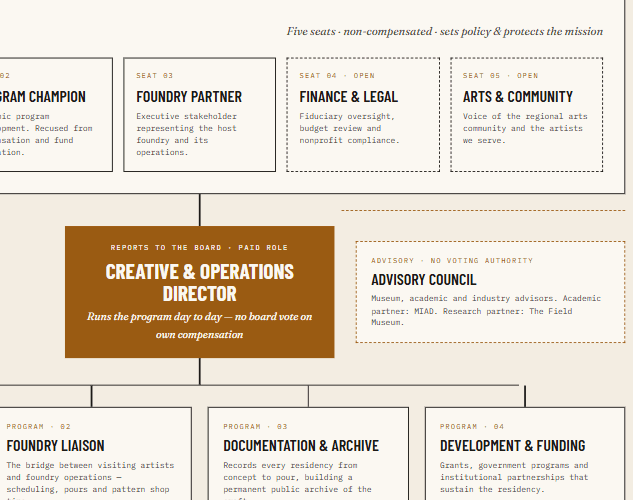
A governing charter, a board structure and a scope of work, plus a year-one budget that mapped costs across each workstream and planned for contingencies. Together they lay the groundwork for the residency to stand on its own as a nonprofit.
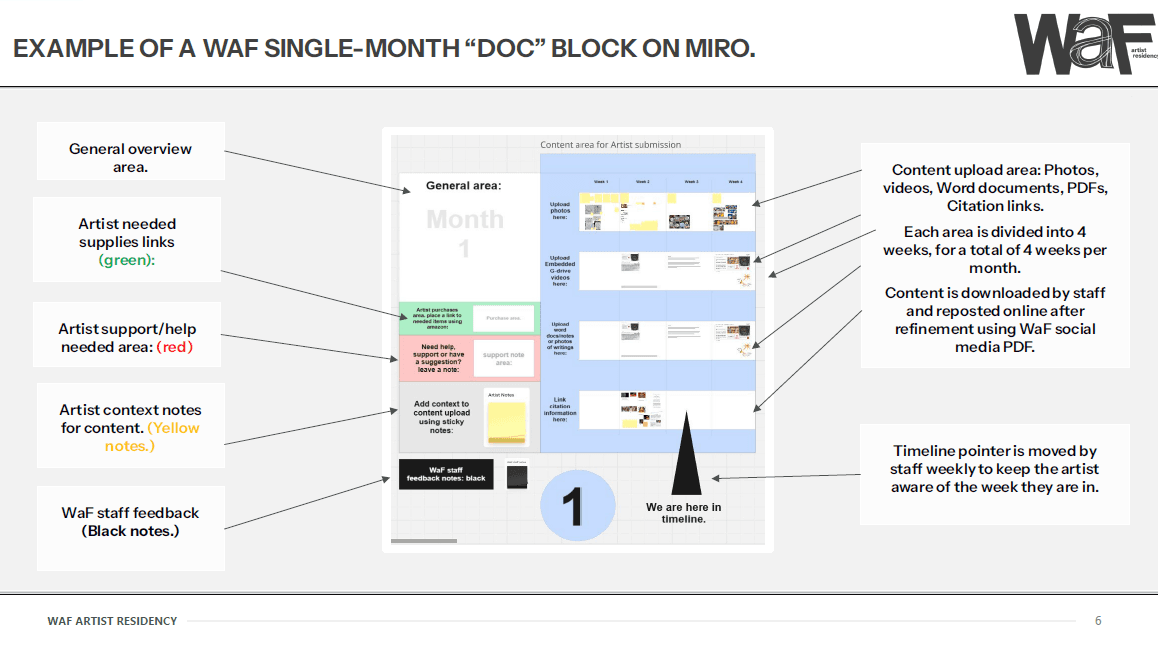
Research, patterns, molds, pours, welding and finishing are captured as they happen. Photos, video, drawings and documents are logged in one place, never rebuilt from memory.

A web app in development where artists log media, track progress and share behind-the-scenes updates. Staff follow each artist's progress, and collaborators pull assets without chasing files.

Archive access at the Field Museum grounded the work in history. Partnerships with schools, museums and trade groups turned a foundry project into a community one.
Each residency runs in two phases. Artists research first, then create on the foundry floor, and both are documented as they happen.
Every project starts with looking. Artists dig into archives, collections and references before anything is shaped. For the Lotus Mirror, that meant Han Dynasty bronze mirrors at the Field Museum and the geometry of Tibetan sand mandalas as inspiration for the sculpture.
Ideas move onto the foundry floor. Artists work side by side with the crew who pour metal every day, from the first pattern to the final weld.
Both phases are recorded as they happen, never rebuilt from memory. Photos, video, sketches and documents are logged in one place, sorted by phase, and shaped into a story anyone can follow, from the first archive visit to the final pour.
The artist's work shared with the community in photos, video, writing and exhibitions.
Each residency ends with a finished set of photos, video and writing the artist can use for shows, grants and press.
The archive captures how sculpture and industry meet in Wisconsin, a resource for schools, museums and future artists.
The foundry gets real stories from its own floor to share with customers, new hires and the community.

WiSCONSIN aLUMUNUM FOUNDRY
WAF Artist Residency PROGRAM
